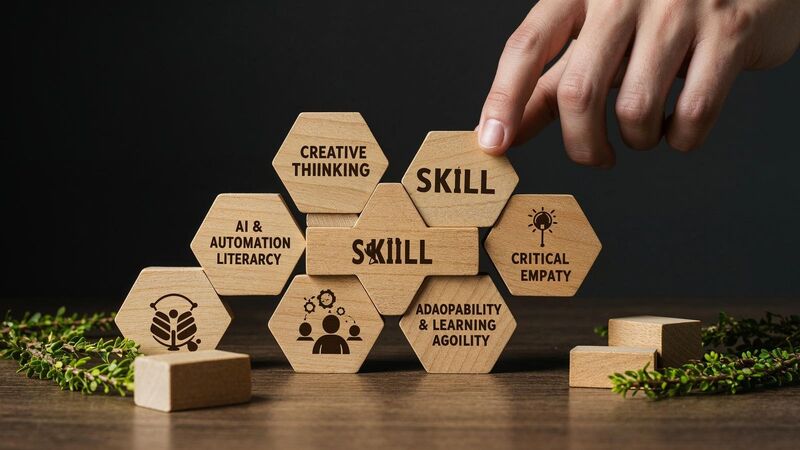
List of the most in-demand professional skills in 2026
The job market is evolving rapidly: recruiters now value soft skills as much as hard skills. At the forefront are adaptability, emotional intelligence, collaboration, autonomy, and hybrid agility. These transferable skills make all the difference on a CV.

Key points to remember
- Adaptability and resilience come out on top according to the Future of Jobs Report 2025 (WEF)
- In France, recruitment agencies cite empathy, curiosity, and analytical thinking as keys to employability.
- LinkedIn’s Workplace Learning Report 2025 highlights the importance of learning related to leadership skills, management, strategic planning, nd mastery of generative AI.
Understanding professional skills
Professional skills represent a set of abilities and knowledge that you use to successfully carry out your professional tasks. They can be acquired through experience, training, or self-directed learning. These skills can be of different kinds and generally fall into two main categories: technical skills and behavioral skills.
Technical skills, also known as “hard skills,” correspond to your technical know-how and expertise in a specific field. This can include proficiency in a software program, knowledge of project management, or language skills.
Behavioral skills, or “soft skills,” refer to your interpersonal skills in a professional environment. These include your ability to work in a team, manage stress, and demonstrate creativity.
These skills are a major asset for your employability and can make all the difference during a recruitment process. It is therefore essential to identify them, develop them, and know how to showcase them.
Different categories of professional skills
Professional skills are divided into several categories beyond technical and behavioral skills. We also distinguish:
- Cognitive skills refer to your ability to think, solve problems, and make decisions. For example, critical thinking and creativity are cognitive skills.
- Digital skills relate to your ability to use digital tools, analyze data, or work in a digital environment. Proficiency in specific software, programming, and data analysis are all examples of digital skills.
- Sales skills: these relate to your ability to negotiate, sell a product or service, or understand customer needs. Negotiation, market knowledge, and customer relationship management are all sales skills.
- Managerial skills: these relate to your ability to lead a team, manage a project, or develop a strategic vision. Leadership, project management, and decision-making are all examples of managerial skills.
Each category of skills has its importance and specificity, and all are likely to be valued depending on the position sought.
Interpersonal skills and technical skills are necessary distinctions
Expertise: technical and professional skills
Technical skills, or know-how, are specific knowledge acquired through training or experience that is necessary to perform certain tasks or jobs. They are often linked to a particular area of expertise. For example, programming for a developer or mastery of labor law for a lawyer.
For 2026, certain technical skills stand out:
- Artificial Intelligence (AI) and data analysis these skills are increasingly in demand in many fields, from IT to finance.
- Mastering digital tools: in an increasingly digital world, being comfortable with digital tools has become essential.
- Project management skills: knowing how to plan and manage a project from start to finish is a sought-after skill in many professions.
The technical skills required vary depending on the job and sector of activity. It is therefore essential to be fully aware of the requirements of the position you are applying for and to train accordingly.
Soft skills: valued personal skills
Personal skills, or soft skills, are intrinsic qualities that determine how a person interacts with their work environment. They encompass aspects such as communication, leadership, adaptability, stress management, and creativity. These skills, sometimes called “soft skills,” are increasingly valued by employers because they allow individuals to adapt their behavior to different situations and foster positive team dynamics. Unlike technical skills, they are not necessarily tied to a specific job or sector and can be transferred from one job to another. For 2026, here are some examples of particularly sought-after soft skills:
- Ability to work in a team: to collaborate effectively with colleagues, to share ideas, and to take into account the suggestions of others.
- Autonomy: being able to work independently, take initiative, and manage one’s time and tasks effectively.
- Problem-solving, finding innovative solutions to complex situations, and demonstrating responsiveness and pragmatism.
- Communication skills: knowing how to listen, expressing ideas clearly, valuing one’s own work and that of one’s team, and managing conflicts.
- Organizational skills: planning work, meeting deadlines, managing priorities.
Examples of soft skills and hard skills
Examples of skills and soft skills vary depending on the sector and the position. Regarding skills, here are some commonly required technical competencies:
- Proficiency in a computer language: essential for digital professions.
- Managing a client portfolio: crucial for sales positions.
- Accounting skills: essential in the financial field.
As for soft skills, certain professional qualities are particularly valued:
- Empathy: knowing how to understand and take into account the feelings of others.
- Adaptivity i he ability to adjust one’s behavior in response to unforeseen situations.
- Autonomy: knowing how to work without constant supervision.
These skills are just examples; each position and each company may have specific expectations. It is important to identify these and include them in your resume and cover letter.
The 10 most sought-after professional skills in 2026
- Adaptability
- Resilience
- Analytical mind
- Emotional Intelligence
- Communication
- Leadership
- Curiosity
- Creativity
- Sense of initiative
- Mastering AI
Skills related to adaptability
Adaptability is a skill increasingly sought after by employers. It is synonymous with flexibility, open-mindedness, and the ability to manage change.
It includes several aspects:
- Change management ability to adapt to new working methods, emerging technologies, or varied professional contexts.
- Flexibility: the ability to modify one’s behavior or working methods according to circumstances.
- Resilience: the ability to overcome difficulties and bounce back from failure.
These skills are particularly valued in a constantly evolving professional environment. They enable one to cope with uncertainty and adapt quickly to new situations.
It is possible to develop one’s adaptability by training in new skills, accepting challenges, and remaining open to learning opportunities.
Communication and interpersonal skills
Strong communication and interpersonal skills have become a prerequisite for most positions. These skills focus on interacting with and developing positive relationships with colleagues, clients, and partners.
- Active listening. This skill is essential for understanding the needs and viewpoints of others. It allows you to react appropriately and effectively.
- Clear and concise expression: It allows information to be shared effectively, whether orally or in writing.
- Diplomacy and conflict management. These skills are essential to maintaining a calm and productive work environment.
- Empathy: It allows us to understand and take into account the feelings and perspectives of others.
- Persuasion is useful for convincing others to adopt a certain point of view or to act in a certain way.
Remember that the development of these skills is possible through practice, training, and feedback.
The ability to take initiative and creativity
Initiative and creativity are essential qualities for anticipating problems and proposing innovative solutions. These two skills are highly valued because they allow one to approach challenges with new perspectives and generate innovative ideas.
- The ability to take initiative is particularly valued by employers as it demonstrates an individual’s capacity to act proactively, make independent decisions, and go beyond the scope of their responsibilities.
- Creativity, meanwhile, is a key skill that allows you to think outside the box, find unique solutions to problems, and innovate. It is particularly useful in a complex and constantly evolving professional environment.
To develop these skills, it is essential to remain curious, to constantly seek to learn, and not to be afraid to take risks or explore new ideas.
The personal qualities that make the difference
Personal qualities are a reflection of your personality and your behavior at work. They influence how you interact with others, solve problems, and manage your work.
According to experts, certain personal qualities will be particularly sought after by 2026:Resiliencec, this quality is essential to overcome challenges and bounce back from failure.
- Curiosity: it drives innovation and continuous learning, assets in a constantly evolving professional environment.
- Integrit: respecting one’s commitments and acting ethically is increasingly valued.
- Proactivity: anticipating needs, taking initiatives, and not waiting to be asked to act are appreciated qualities. Optimism. In the face of uncertainty, adopting a positive attitude can make all the difference.
These qualities can be highlighted in your CV, linked to concrete examples that illustrate their practical application in your professional career.
Skills acquired and to be developed-a long-term vision
Identify your acquired skills
To identify your acquired skills, start by listing your professional experiences, training, and concrete achievements. Ask yourself the following questions:
- What tasks have you completed?
- What tools or methods did you use?
- What positive feedback have you received?
Taking notes helps ensure nothing is forgotten. Next, classify these skills into three main categories: knowledge (theoretical knowledge), know-how (technical skills), and soft skills (human qualities).
For a more precise assessment, you can use online tools such as the Skills Passport or complete a skills assessment. These resources will help you gain a clear and objective view of your acquired skills.
Finally, don’t forget to update this list regularly, especially after a new professional experience or training.
Developing new skills-how to go about it?
To develop new skills, several options are available. Self-learning is a good starting point, thanks to the many resources available online, such as tutorials, MOOCs, and webinars. Don’t hesitate to use these tools to become more independent in your learning.
Professional training is another effective solution. It allows you to acquire new, targeted skills that are recognized in the job market. Contact your company or France Travail to find out about available training opportunities. For employers, it’s possible to organize professional training for your employees using dedicated training software.
On-the-job learning is also a very enriching approach. By participating in projects, taking initiatives, or tackling new challenges at work, you can develop new, concrete skills that are directly applicable to your professional life.
Don’t forget to regularly ask for feedback from your colleagues or manager. This feedback will allow you to identify areas where you can still improve and to measure the development of your skills.