
10 essential skills every leader will need to master by 2026
By 2026, the best leaders will be those capable of orchestrating the convergence between intelligent machines, human teams, organizational cultures, and customer expectations. This requires a combination of technological literacy, managerial maturity, and political acumen in leading change.
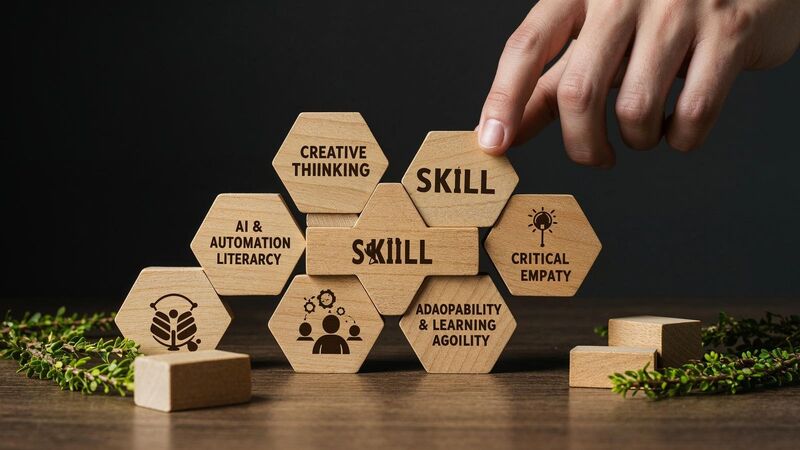
Studies by the World Economic Forum show that nearly 39% of core skills in jobs are expected to evolve by 2030, with an acceleration in AI, data, cybersecurity, but also creativity, resilience, and continuous learning.
1. Management of agent workflows (Agentic Workflow Management)
AI agents will no longer be mere assistants: they will execute end-to-end processes ( customer onboarding, case processing, after-sales service follow-up, sales forecasting, etc.). Recent analyses in CIO and at Forrester converge: by 2026, the value created will come less from “super models” than from the ability to orchestrate specialized, well-defined agents, integrated into robust workflows and governed by clear rules.
For a leader, this implies three levels of competence:
- Architecture understanding at a high level of how agentic workflows are designed (sequence of tasks, API calls, feedback loops, human supervision).
- Governance: setting “safeguards” (data policies, limits of action, criteria for escalation to human) and arbitrating what must remain under human control.
- Organizational design: treat agents as a new category of “digital collaborators” and adapt roles, responsibilities, processes, and indicators accordingly (e.g., clearly separate “work performed by the agent” and “human validation/judgment”).
Recent McKinsey studies on “agentic AI” also show that organizations that explicitly structure these practices (strategy, operating model, data adoption) capture much more value from AI than others.
2. Innovation and entrepreneurship related to AI
Recent reports from Harvard Business Review and McKinsey converge on one point: the majority of companies remain stuck at the “AI pilot” stage without scaling up, due to a lack of strategic leadership on innovation.
The AI entrepreneur on the corporate side is not the Chief Scientist; it’s the leader who knows:
- Identify high-value use cases (reduced processing times, improved customer satisfaction, new service offerings, etc.).
- Structuring the approach: rapid experimentation, MVP, impact assessment, then industrialization under robust governance.
- Aligning AI with strategy: not chasing technology, but chasing business KPIs (cash flow, NPS, retention rate, productivity, carbon footprint…).
The IBM Responsible Leadership Report shows that the most AI-advanced leaders are those who link AI to very concrete issues (customer experience, operational efficiency, new business models), while also taking a clear stance on risks and limitations.
3. Data Governance (Data Stewardship)
Data is not just a technical asset; it is becoming a strategic raw material, subject to increasingly stringent regulatory, ethical, and reputational constraints. Stanford’s AI Index 2024 reports and McKinsey studies on value creation through AI show that high-performing organizations share a structured data governance framework: quality, traceability, accessibility, security, and clear responsibilities (Chief Data Officer/Chief Data Officer, business units, IT).
For a leader in 2026, the key skill is not “doing data”, but:
- Setting the framework: who is responsible for what? How do we balance business use and risks?
- Understanding the issues of bias and representativeness: a model trained on partial or biased data generates questionable decisions, with significant legal and reputational risks.
- Supporting the data literacy of teams: it is no longer enough to have a data team; managers and employees must understand the major concepts (quality, correlation vs causality, limitations of models).
Gartner and other recent studies also show that the role of CDO/CDAO is shifting from a “governance & compliance” role to a highly strategic one, steering AI from end to end and serving as a pivot between technology and business.
4. AI Ethics
Responsible AI programs are no longer a luxury for large technology companies; they are becoming a regulatory requirement (Europe, United States, etc.) and a key factor in building trust among customers, employees, and investors. Analyses by Harvard (HBS Online), Harvard DCE, and the “Policy & Governance” chapters of the AI Index 2024 highlight the importance of an explicit framework centered on transparency, fairness, security, explainability, and accountability.
For leaders, this translates to:
- Anchoring ethics in AI investment decisions (we are not deploying a profitable use case but a socially destructive one).
- Establish a multidisciplinary governance structure (legal, business, tech, HR, compliance, sometimes external representatives).
- Anticipating the human impacts: employment, retraining, workplace monitoring, and respect for privacy.
Several reports on skills shortages in AI also show that “AI + ethics/security” profiles are among the rarest and most sought-after, which reinforces the responsibility of leaders not to treat these issues as a mere legal annex.
5. Data Communication & Storytelling
Research in data storytelling (HBS Online, MIT Sloan, specialized firms) converges: organizations do not lack dashboards, they lack clear narratives that link the numbers to the decisions.
By 2026, a leader will need to be able to:
- Moving from “what” to “why”: explain not only what the model or dashboard says but why this trend appears and what it implies (risks, opportunities, trade-offs).
- Translating AI decisions: making the determining factors of an algorithmic recommendation understandable (as far as possible), to avoid the “black box” effect that destroys trust.
- Adapt the level of discourse: n executive committee does not need the same level of detail as a data engineer or an agency manager.
Several recent studies highlight the emergence of a key skill: “decision intelligence,” at the intersection of critical thinking, data literacy, and managerial judgment. Human resources departments are encouraged to develop this capacity in managers, so they can question models, challenge results, and make responsible decisions.
6. Cybersecurity Strategy
The WEF’s Global Cybersecurity Outlook 2025 reports and recent analyses of AI-powered social engineering and phishing attacks are very clear: the attack surface is exploding, the human factor remains the primary entry point, and deepfakes and AI-generated emails are becoming frighteningly credible.
The leader’s role here is to:
- Create a “security-first” culture: regular awareness training, the right to make mistakes and report incidents, and recognition of those who report attempted fraud.
- Linking cybersecurity and business choices: every new AI project (agents, automation, data collection) must be evaluated from the perspective of the risks of leakage, model hijacking, and system compromise.
- Integrating deepfake risk into governance: enhanced validation of wire transfer orders, instructions supposedly sent by a manager, and “sensitive” videos and audios.
The WEF notes that the majority of executives surveyed now consider cyber risk to be one of the main business risks, on the same level as financial or geopolitical risks.
7. Resource Planning (Workforce Planning in the Age of Agents)
Analyses from Forrester, WEF, a nd McKinsey show that the issue is no longer whether AI will transform jobs, but how to organize work between humans and intelligent agents.
A leader must:
- Mapping tasks: identifying what can be automated (routines, compilations, consistency checks) and what still requires judgment, creativity, and empathy.
- Anticipating upskilling /reskilling: reports highlight that employees are often more ready for AI than their managers imagine, but they need a framework for skills development and clear prospects.
- Define the skills to keep in-house (AI architecture, supervision, complex customer relationship, performance management) vs what can be outsourced or industrialized.
The WEF insists that “sustainable” human skills: analytical thinking, creativity, resilience, collaboration… are growing in importance, complementing technological skills.
8. Learning Agility
Studies on the future of work show that the shelf life of technical skills is rapidly shrinking: a tech stack, tool, or framework can become obsolete in just a few years. The Future of Jobs Report 2025 clearly highlights the growing importance of curiosity, the ability to learn, and flexibility as critical skills for managers.
For a leader, learning agility translates into:
- A “learning leader” stance leading by example by training oneself in AI, data, and new working models, rather than delegating entirely to the IT department or experts.
- The ability to question one’s own mental models: accepting that past experience may be less predictive in an AI-driven environment.
- Integrating learning into the workplace: pilot projects, communities of practice, incident reviews, structured feedback, peer learning …
More and more HR reports talk about a shift from “one-off training” to the ability to learn continuously, which is becoming an explicit criterion for evaluating and promoting managers.
9. Mastery of ESG/CSR issues
Recent work on sustainable leadership skills shows an increasingly strong integration of ESG/CSR issues at the heart of corporate strategy. A 2025 blueprint on ESG/CSR leadership skills highlights three pillars: climate risk governance, sustainable value chains, and mastery of ESG data and its auditing.
Meanwhile, studies published on platforms like Harvard Law School (Corporate Governance) show that for many CEOs, sustainability is no longer a secondary communication topic: it is increasingly integrated into strategic decisions (capex, location, innovation, supply chain).
For a leader, this means:
- Understanding reporting and regulatory mechanisms (CSRD, taxonomies, sector standards) is not to be acted upo,n but to take control.
- Linking AI and ESG/CSR: using data and AI to better measure footprint, simulate scenarios, optimize resources, but also monitor social and governance risks.
- Avoid “ESG/CSR washing”: recent examples of reorganization of ESG/CSR structures in some large companies show that credibility is maintained only if the choices are consistent and transparent over time.
10. Emotional intelligence and empathy
Several recent studies (McKinsey, 6Seconds, Forbes, HP Work Relationship Index, etc.) point to a dual movement:
- AI takes over more analytical and repetitive tasks.
- Employees expect more empathy, clarity, and recognition from their leaders.
Research shows, for example, that emotionally intelligent leadership is correlated with better performance, team resilience, and a more serene adoption of AI.
The key skill for 2026
- Knowing how to listen to and decode weak signals (fatigue, “quiet quitting”, anxiety about AI).
- To have a clear and honest discussion about what AI will change, and what it will not replace.
- Create psychologically safe environments where employees can express their doubts, experiment, make mistakes, and learn.
Studies on the loss of trust in leaders show that criticism focuses less on strategy itself and more on a perceived lack of empathy, transparency, and consistency. Conversely, organizations that combine technological transformation with strengthened human leadership see greater AI adoption and stronger talent retention.
Conclusion-AI-enhanced leadership, not dehumanized leadership
The skills needed to lead effectively in 2026 represent a profound break with the standards of previous decades: leadership can no longer be just “business + technical”, it is becoming “business + AI + human”.
Reports from the World Economic Forum, McKinsey, Stanford HAI an d numerous observatories all show the same trend: successful organizations combine technical excellence, responsible governance, and massive investment in human skills.